
Steel-framed glass interior doors create a boundary between adjoining rooms while preserving light and a visual connection. Their steel divisions give the opening a defined pattern, and the glass allows one space to remain visible from the other. Within this shared appearance, however, the way a door opens can change its role in the interior. A hinged door and a pivoted door may look similar when closed, yet their supporting fittings create different movements when someone passes through.
The distinction begins with the position of the moving leaf’s support. A hinged door uses hinges along one vertical side. A pivoted door uses fittings at the top and bottom to establish its rotating axis. These structures should be understood alongside the operating features of the particular door being discussed. The position of the fittings explains the movement, while features such as sealing and self-closing determine how our configurations differ in use. Tengyu’s Metal Frame Glass Hinged Door and Metal Frame Glass Pivoted Door ranges offer these two approaches to a swinging glass door. The hinged configuration provides better perimeter sealing. The pivoted configuration discussed here combines upper and lower fittings with hydraulic self-closing and a 180-degree opening range. Both retain the character of steel and glass, giving each structure a distinct purpose within a similar visual language.
Side hinges provide better perimeter sealing
A hinged door connects its moving leaf to the frame through hinges positioned along one vertical side. When opened, the leaf swings around that side hinge line; when closed, it returns to the frame. The side connection makes the relationship between the stationary frame and the moving leaf easy to see. The door’s movement starts at one edge and carries the rest of the leaf through the adjoining space.
In our hinged configuration, better perimeter sealing is the main advantage over the pivoted configuration discussed here. This places the emphasis on the door in its closed position. The glass continues to provide visibility between the rooms, while the more closely sealed perimeter strengthens the distinction between them. For an interior where a closed boundary is the priority, this is a meaningful reason to consider the hinged structure.
A study beside a living area or a meeting room illustrates this combination of separation and visibility. The door can define the room without replacing the glass connection with an opaque surface. Better perimeter sealing concerns the closed door assembly, however; it does not by itself establish a tested acoustic rating. The advantage described here is the relative sealing of our two configurations, rather than a quantified sound insulation claim.
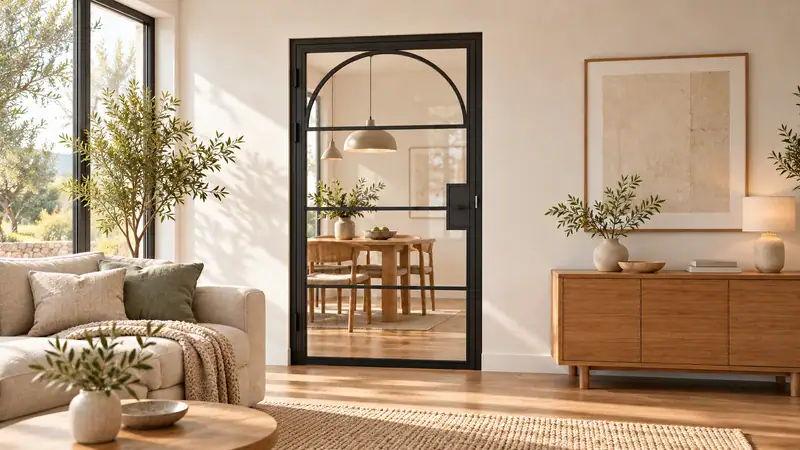
Our hinged doors combine steel frames with tempered glass. The black powder-coated arched design shown below illustrates how the steel can form a decorative pattern within the glass door. The curve contributes to the appearance, while the hinges along the side determine the opening action. These are separate aspects of the same door: one shapes what the entrance looks like, and the other shapes how the leaf moves.
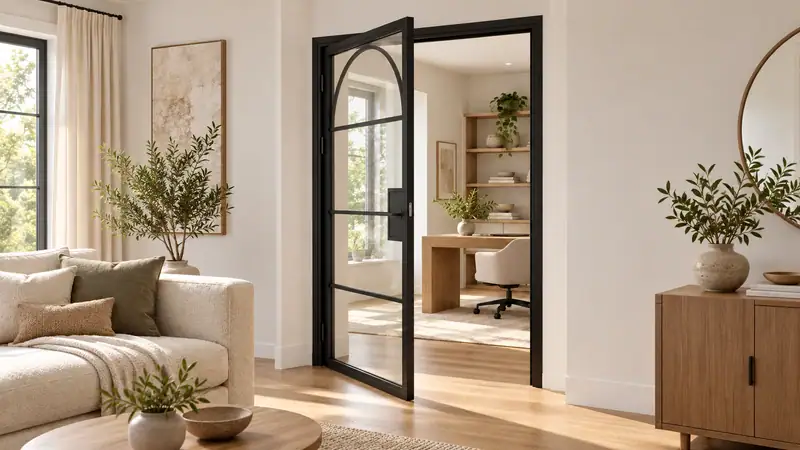
Our hinged range includes single and double doors. A single leaf gives the entrance one moving panel, with the steel and glass pattern contained within that composition. A double-door layout brings two leaves together in a paired arrangement across a wider opening. The appearance changes with the number of leaves, but the principle of support remains the same: each moving leaf uses a side-hinged structure.
Both arrangements need space for their leaves to swing. The closed view therefore shows only part of the door’s relationship with the room. In the open position, the leaf occupies part of the surrounding area. This is why the same hinged construction can feel different in different layouts, even when its material and pattern remain similar.
Upper and lower pivots support hydraulic self closing
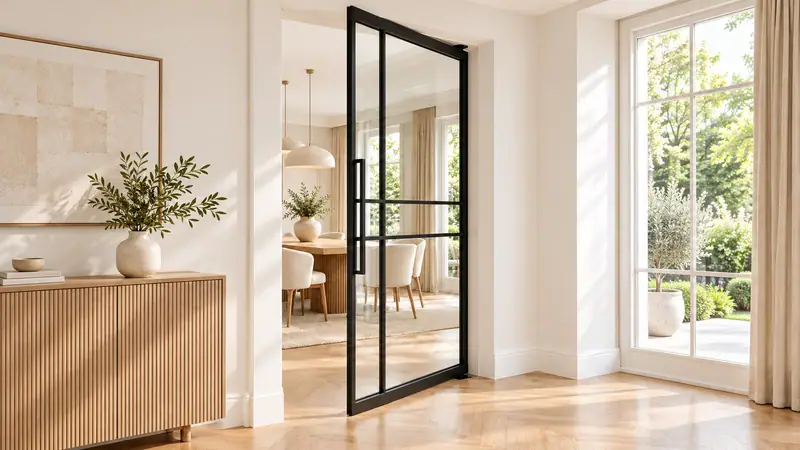
A pivoted door rotates around a vertical axis established by fittings at the top and bottom of the leaf. Its support is arranged differently from the conventional hinges along the side of a hinged door. The distinction is visible in the opening movement: the leaf turns around the line between its upper and lower pivot fittings. The steel-and-glass appearance can remain familiar while the mechanism supporting that movement changes.
In the Tengyu pivoted configuration discussed here, the upper and lower pivot structure is combined with hydraulic self-closing and a 180-degree opening range. These are the operating features of this configuration. They explain its appeal more clearly than appearance alone, particularly where the movement of the leaf and its return after passage are central to the way connecting rooms are used.
The hydraulic mechanism controls the return movement after the leaf has been opened. A person opens the door manually, and the mechanism provides the self-closing action. Opening and closing therefore have different roles in the operating sequence: the user initiates passage by moving the leaf, and the hydraulic action brings it back afterward. This is the function referred to here as hydraulic self-closing.
Between connecting rooms where people pass through regularly, that return action can be useful when the door is intended to close again after use. The advantage concerns what happens after someone opens the door. It differs from the hinged configuration’s emphasis on better perimeter sealing when closed, giving the pivoted configuration its own reason for consideration within a steel-and-glass interior.
The 180-degree opening range gives the pivoted leaf a wide range of movement. That range describes the movement available from the configuration, while the room determines how much of it can be used in practice. Nearby walls, furniture and handles still need clearance. An opening range and an unobstructed opening path are therefore related, but they describe different aspects of the door in an actual space.
Hydraulic self-closing and the 180-degree opening range work together in the description of this pivoted door. One concerns the leaf’s return after opening; the other concerns how far it can move. Considering both features makes the operating difference easier to understand than treating the pivot fittings as a purely visual detail.
Choose the structure around the room layout
The room layout gives context to the advantages of each structure. A hinged door suits an arrangement where the leaf can swing toward one side and better perimeter sealing is a priority. In the study beside a living area described earlier, the closed door can create a more closely sealed boundary while retaining the visibility of glass. The side-hinged action and the closed perimeter are both part of that relationship between the two rooms.
The opening path also forms part of the layout. Furniture and circulation occupy the same surrounding space into which a door swings. This does not change the hinged door’s sealing advantage, but it explains why the closed appearance alone cannot describe its use. The leaf’s movement is part of the interior composition as well as a function of the fittings.
A pivoted door offers a different emphasis where closing after passage is useful and the surrounding room accommodates its opening range. Its leaf moves around the vertical axis established by the pivot fittings. If that axis sits inward from the edge, the smaller section behind it also moves. The visible movement can therefore include areas on both sides of the pivot line, depending on the axis position.
This relationship between the axis and the leaf helps explain the pivoted configuration in spatial terms. Its 180-degree range remains an operating feature, but nearby elements still influence the movement available in the room. The practical distinction is the combination of that rotating action with hydraulic self-closing, rather than a change to the basic purpose of a glass partition between adjoining spaces.
Coordinate the steel and glass appearance
Both structures retain the visual character of steel and glass. Steel divisions establish a pattern across the opening, while clear tempered glass keeps adjoining rooms visually connected. The pattern is read across the surface of the closed door; the supporting structure becomes more apparent as the leaf opens. Similar closed appearances can therefore accompany different operating experiences.
The arched hinged design shown earlier demonstrates this distinction. Its steel pattern contributes to the entrance’s appearance, while its side hinges provide the movement. The pivoted configuration likewise combines a steel-and-glass appearance with its own supporting fittings. Appearance and operation can be considered together without treating them as the same feature.
The clearest distinction remains the advantage each configuration brings: better perimeter sealing for the hinged door, and hydraulic self-closing with a 180-degree opening range for the pivoted door discussed here. Both separate adjoining rooms while preserving a visual connection. Their different supporting structures allow that shared steel-and-glass character to serve different priorities within an interior.
Planning a steel-and-glass doorway for your next project
Share your opening dimensions, room layout and preferred design with Tengyu to discuss which hinged or pivoted configuration suits your space. Let us know whether perimeter sealing or hydraulic self-closing matters most, and we can help you explore the options.