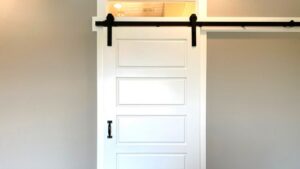

To measure for a barn door, measure your opening’s width and height at three different points, use the largest measurements, add at least 2 inches to the width for overlap, add 1 inch to the height, and calculate your track length by multiplying the door width by two. You also need to check that you have enough ceiling clearance above the opening and wall space beside it for the door to slide open.
This guide walks you through each measurement you need to take, the tools required, and common mistakes that trip people up during the process.
Understanding Barn Door Measurements
Barn doors need extra width and height beyond your opening size, and the way you measure differs based on whether you’re installing one door or two.
Why Barn Door Sizing Differs from Swing Doors
Regular hinged doors fit inside the door frame with almost no gaps. Barn doors work differently because they hang on a track and slide along your wall surface.
Your barn door sits in front of the opening instead of inside it. This means you need a door that’s bigger than the space you’re covering.
The Importance of Overlap and Privacy
Overlap refers to how much your barn door extends beyond the edges of your opening. This extra width is what keeps your room private and blocks light.
Standard overlap guidelines:
- Regular rooms: Add 2 inches total (1 inch per side)
- Bathrooms and bedrooms: Add 4-6 inches total (2-3 inches per side)
More overlap means better privacy. For example, if your opening measures 36 inches wide, a 38-inch door gives you basic coverage. A 40-42 inch door provides better light and sound blocking for bathrooms.
Single vs. Double Barn Doors
Single barn doors work well for standard doorways up to 36 inches wide. You measure the opening width, add your overlap, and multiply by 2 for track length.
Double barn doors meet in the middle and are better for wider openings. Each door should be slightly wider than half your opening width. Use this formula: (Opening width ÷ 2) + 1 inch per door, plus 2-3 inches where they meet.
For a 60-inch opening, you’d need two 32-inch doors (60 + 4 inches overlap = 64 ÷ 2 = 32 inches each).
Step-by-Step Guide to Measuring for a Barn Door
The right barn door dimensions requires measuring your opening width and height, then adding extra inches for proper overlap. You’ll also need to account for any trim around your doorway to give complete coverage.
Gathering Your Tools and Preparing the Space
Grab a tape measure, a pencil, and paper to write down your measurements.
Before you start measuring, clear the area around your doorway. Move any furniture or items that might get in your way. This gives you room to work and helps you measure accurately.
Check if your doorway has trim or casing around it. This matters because it changes how you’ll measure.
Also look at the space above your door opening. You need at least 5.5 inches from the top of the opening to your ceiling for standard hardware.
Measuring Door Opening Width
If you have trim around the doorway, measure from the outer edge of the trim on one side to the outer edge on the other side.
Take three measurements at different heights: top, middle, and bottom. Doorways aren’t always perfectly square, so these measurements might differ slightly. Write down the widest measurement.
For standard doorways, add 4 inches to this width (2 inches on each side). This overlap prevents gaps and gives you privacy.
For bathrooms or spaces where you need more privacy, add 6 inches total (3 inches per side). Remember that barn doors sit slightly off the wall, so this extra coverage matters.
Measuring Door Opening Height
Measure from the floor straight up to the top of your door opening. Use your tape measure and keep it level against the wall.
Take this measurement in two or three spots across the width of the opening. Use the tallest measurement you get.
Most barn door heights match this measurement or add 1 inch for better coverage at the top. Your barn door size should cover the opening fully without dragging on the floor.
If you have low ceilings or limited space above the opening, measure the distance from the top of the opening to your ceiling. This helps you figure out if you need special low-profile hardware.
Calculating Overlap and Final Door Size
Now you can calculate your final barn door dimensions. Start with your opening width measurement and add your overlap inches based on your privacy needs.
Standard barn door width formula:
- Opening width + 4 inches = door width (for regular rooms)
- Opening width + 6 inches = door width (for bathrooms)
Your barn door height typically equals your opening height plus 1 inch. This gives you proper coverage without the door touching the floor.
Write down these final measurements clearly. Double-check your math before ordering your door. A barn door that’s too small won’t cover your opening properly, while one that’s too large might not fit your wall space or glide smoothly on the track.
Key Considerations for Barn Door Installation
Getting the wall space right and choosing compatible hardware ensures your sliding barn door operates smoothly and looks professional. These factors directly impact both the function and appearance of your installation.
Wall Clearance and Track Placement
Your barn door needs adequate space above the opening for the track and hardware. Most barn door hardware requires 6 to 8 inches between the top of your doorway and the ceiling.
If you’re working with crown molding or low ceilings, you’ll need low-profile hardware instead. These systems reduce clearance needs to about 4 inches. Ultra-low-profile options exist that need only 2 inches.
Check the wall beside your opening too. You need clear wall space equal to at least your door’s width. When you slide the door open, it has to move somewhere. Mark this area with a pencil to spot any light switches, outlets, or vents in the path.
Trim, Molding, and Surface Irregularities
Door casing around your opening affects where you measure. If you have trim, measure from the outside edge of the trim on both sides. Without trim, measure from inside the jamb edges.
Older homes often have uneven walls and floors. Take three measurements for width (top, middle, bottom) and three for height (left, center, right). Always use the largest measurement.
Your floor might not be level either. Measure height from the highest point on your floor to prevent the door from dragging in spots.
Selecting Hardware and Accounting for Door Thickness
Match your hardware to your door’s weight and thickness. Standard barn door thickness ranges from 1.375 to 1.75 inches for solid wood doors.
Check the weight capacity of your track system before buying. Heavier doors need stronger hardware with reinforced wall mounting. Your barn door installation will fail if the track can’t support the weight.
The hardware kit should include the track, rollers, floor guides, and mounting brackets. Make sure the rollers fit your door thickness before ordering.
Standard and Custom Barn Door Sizes
Most barn doors come in standard sizes that fit common openings, but custom options exist for unique spaces. Understanding typical dimensions helps you plan your project and determine if you need a standard or custom door.
Popular Width and Height Options
Standard barn door widths typically range from 24 to 42 inches. The most common sizes are 30, 32, 36, and 42 inches wide. These widths match standard doorway openings in most homes.
For height, you’ll find standard options between 80 and 84 inches. An 80-inch door works for most interior openings, while 84-inch doors suit slightly taller spaces.
|
Common Standard Sizes
|
Width (inches)
|
Height (inches)
|
|---|---|---|
|
Small Opening
|
30″
|
80″
|
|
Medium Opening
|
32″
|
80″
|
|
Large Opening
|
36″
|
84″
|
|
Extra Wide
|
42″
|
84″
|
Remember that your barn door should be larger than your actual opening. You need extra width for proper overlap on each side.
Determining the Best Thickness
Barn door thickness affects both appearance and durability. Standard interior barn doors are usually 1.375 to 1.75 inches thick.
Thicker doors (1.75 inches) work better for heavier materials like reclaimed wood. They also provide better sound dampening and feel more solid. Thinner doors (1.375 inches) weigh less and need lighter hardware.
Your door’s thickness must match your hardware capacity. Check weight limits before choosing.
Custom Sizing Tips
Older homes often have non-standard openings that need precise measurements. You can order custom doors sized to one-eighth of an inch to covers the opening properly without gaps. Custom sizing costs more but guarantees a perfect fit.
Consider custom doors for oversized openings, angled ceilings, or spaces with unusual trim work. They’re also helpful when you want specific proportions for your room’s design.
Contact Our Experts for a Custom Quote
If you have a non-standard opening or are looking for premium hardware and door systems, the team at Tengyu is ready to assist. We offer a wide range of door accessories, locks, and latches to complete your project.
To receive a detailed estimate, Request a Quote. You can fill out our contact form with your dimensions, company details, and any specific design files. We provide professional guidance to your door system.
Frequently Asked Questions
What dimensions should I consider before purchasing a barn door?
You need to measure three main things: the width of your door opening, the height from floor to the top of the opening, and the available wall space beside the opening. Don’t forget to measure any molding around your doorway too.
Can you guide me on how to properly size a barn door in relation to my doorway?
Add at least 2 inches to your opening width and 1 inch to the height. This extra size covers gaps and gives you privacy. Measure at multiple points since openings can be uneven.
I’m curious about the necessary clearance for a sliding barn door – any tips?
Your door should sit about 1/2 inch above the floor. Make sure you have wall space that’s at least double your door width so the door can slide completely open.
How does door thickness affect the measurements for a barn door installation?
Thicker doors need hardware that extends further from the wall. Check your hardware kit requirements to ensure proper clearance from the wall and any baseboards.
Could you explain how to calculate the overlap needed for my barn door to cover the opening adequately?
Add 1 inch on each side of your opening width. More overlap means less light and sound coming through the edges.
What’s the best way to ensure my barn door will slide smoothly once installed?
Use a track that’s at least twice your door width. Level installation and quality hardware make the biggest difference in smooth operation.