
The opening method affects the usable opening width, required clearance, hardware, and maintenance of an interior window. Fixed glass has no moving sash. A sliding pane moves horizontally within the frame. A swinging pane opens on hinges and therefore needs clear space in front of it.
This guide compares the three formats so that architects, contractors, distributors, and project buyers can select the operating type before confirming the frame pattern, glass, and hardware.
Fixed, sliding, and swinging interior windows compared
| Question | Fixed pane | Sliding pane | Swinging pane |
| Does it open? | No | Yes, horizontally | Yes, on hinges |
| Main advantage | No operating hardware | Opens without a swing clearance | Larger unobstructed opening |
| Clearance required | None for sash movement | Lateral travel space within the frame | Clear space for the sash to swing |
| Typical application | Borrowed light and visibility | Counters and work areas | Service points requiring a larger opening |
| Maintenance focus | Glass and frame | Track and moving sash | Hinges, handle, latch, and glass |
Fixed interior windows: no opening hardware
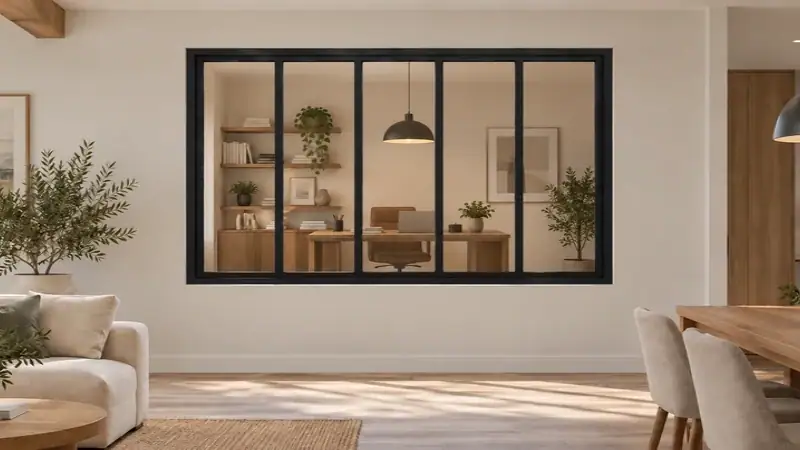
A fixed interior window does not open and therefore requires no sash track or hinges. It is suitable where the main purpose is to transfer light or provide visibility between rooms. Because no opening clearance is needed, fixed glass can also be positioned above a counter or behind furniture.
Tengyu’s TKC-GC01 fixed glass window uses a black powder-coated carbon-steel frame with three panels of 4 mm clear tempered glass. It is designed for residential and commercial interiors.
Choose fixed when
- The opening is primarily for daylight and visual connection.
- Furniture sits close to the wall.
- The project calls for the fewest moving components.
- Ventilation is provided by another window or mechanical system.
Fixed glass is not suitable when the window must provide ventilation or a direct opening between the rooms.
Sliding interior windows: flexible without a swing arc
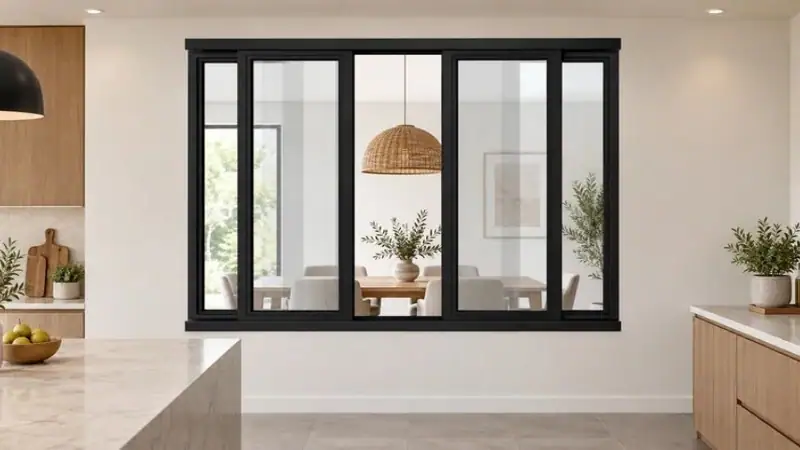
A sliding sash moves horizontally within the window frame and does not project into either room. This makes it practical above counters, beside furniture, or next to a narrow circulation route. Part of the framed opening remains occupied by the overlapping sash when the window is open.
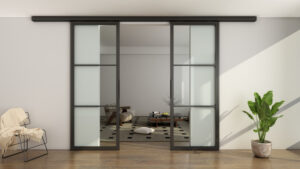
Tengyu’s TKC-GC04 sliding interior window combines two fixed side panes with two sliding center panes in a black powder-coated carbon-steel frame. It uses 4 mm clear tempered glass.
Choose sliding when
- Clear space in front of the window is limited.
- The window needs to open without a projecting sash.
- A hinged pane would conflict with furniture or a counter.
- The opening will be used intermittently.
Sliding windows provide less clear opening than their overall frame width suggests, because one or more panes overlap. If maximum access matters, compare the opening width with a swinging design.
Swinging interior windows: a larger clear opening
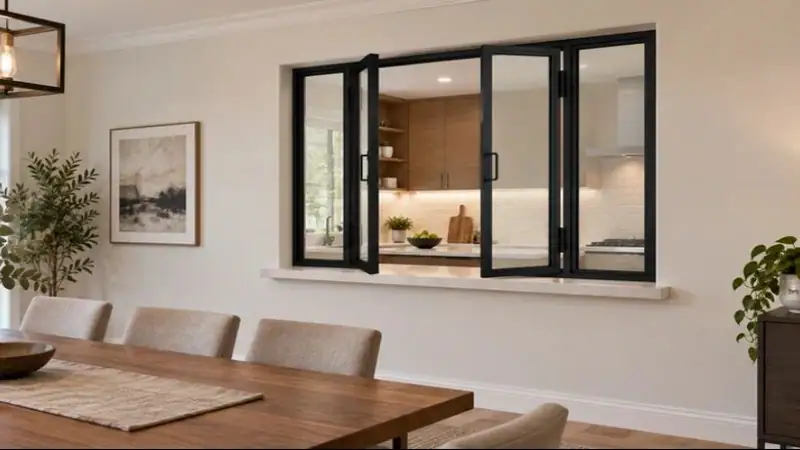
Swinging panes open on side hinges and can provide a larger unobstructed opening than sliding panes of a similar overall size. The trade-off is the required swing clearance: worktops, cabinets, furniture, and circulation routes must remain outside the sash movement.
Tengyu’s TKC-GC03 swinging interior window combines two fixed side panes with two central swing panes. It uses a black powder-coated carbon-steel frame and 4 mm clear tempered glass.
Choose swinging when
- The project requires a larger practical clear opening.
- The window is used as an active service or communication point.
- The sash has a safe, unobstructed opening path.
- A conventional hinge-and-handle action is preferred.
Confirm that the selected opening direction does not obstruct furniture, work surfaces, or a circulation route.
How to decide in five questions
- Is the opening mainly for light? Choose fixed glass.
- Must the pane open without projecting into either room? Consider sliding glass.
- Is a larger unobstructed opening required? Consider swinging glass.
- Is furniture close to the wall? Check the sliding travel space and avoid a swinging sash.
- Does the project need privacy? Use frosted, reeded, fluted, or mixed glass in any of the three formats.
Compare the clear opening, not only the frame size
The overall width and height of an interior window do not indicate how much of it can be opened. A fixed window provides no open area. In a sliding configuration, the moving sash overlaps another part of the window, so the usable opening is smaller than the complete frame. A swinging pane can open more of its framed section, although the hinges, handles, and frame still affect the final clear dimensions.
This distinction matters at service counters and other locations where the opening has a practical function. Compare the required usable width and height with the open position of the selected configuration. Two windows with similar external dimensions may provide different clear openings because their pane layouts and hardware differ.
Consider how often the window will be opened
A pane that opens several times a day places different demands on hardware and cleaning access than one used only occasionally. A sliding sash keeps the area in front of the window clear, but its track must remain accessible. A swinging sash has a direct opening action, but the area within its swing path must remain unobstructed whenever it is used.
If the project only requires daylight and visibility, adding operating hardware may provide no practical benefit. Where regular communication, ventilation, or direct access is needed, the opening method should be selected for that use rather than added as a decorative feature.
Frame, glass, and hardware still matter
The operating type is only one part of the selection. Frame finish and mullion spacing affect how the window coordinates with nearby doors, cabinetry, and partitions. Clear glass maintains direct views, while frosted, reeded, fluted, or tinted glass limits visibility to different degrees. The required safety-glass specification depends on the location and applicable local requirements.
The hardware also differs by operating type. A sliding window uses a track and moving sash, while a swinging window uses hinges, a handle, and a latch. Available hardware and glass options vary by model, and our team can confirm the choices available for the selected configuration.
Site conditions that affect the choice
- Wall thickness and sill height affect the size and position of the frame.
- A sliding sash needs sufficient lateral travel within the window assembly.
- A swinging sash needs an unobstructed opening path.
- Tracks, hinges, and both faces of the glass should remain accessible for cleaning.
- Nearby counters, cabinets, doors, and circulation routes can limit the available opening method.
Match the operating type to the location
Above a kitchen or service counter, a sliding pane can open without occupying worktop space. Fixed glass is suitable beside dining furniture or in a meeting-room wall where only light and visibility are required. A swinging pane suits a service point that needs a larger clear opening, provided that the sash does not obstruct the work area or circulation route.
The same logic applies across offices, hospitality projects, clinics, and residential developments. Select the operating type from the required opening size and available clearance rather than from appearance alone.
Coordinate the window with the surrounding partition
An interior window may sit beside a glass door, within a steel-framed partition, or below a transom. Matching the frame finish and aligning the principal mullions gives the wall a consistent appearance. Where different glass types are used, place privacy glass only where direct views need to be limited.
Plan repeated openings across a larger project
Commercial, hospitality, and multi-unit residential projects may use interior windows in several locations. Not every opening needs to operate in the same way. Fixed panes can be used where only light and visibility are required, while sliding or swinging panes can be limited to locations that need an open connection.
Keeping common head heights, frame finishes, and mullion spacing across these variations makes the window schedule easier to review and gives the completed project a consistent appearance. The operating type can then change according to the clearance and function of each location while the frames retain the same overall appearance.
Frequently asked questions
Which interior window gives the most privacy?
Privacy depends mainly on the glass and the viewing angle. Frosted, fluted, reeded, or tinted glass can be used in fixed, sliding, or swinging frames.
Are sliding windows harder to maintain?
They require track and moving-component cleaning in addition to normal glass care. The track should remain accessible after nearby counters or furniture are installed.
Can different opening types be used in one project?
Yes. Different locations can use different opening methods. Matching frame profiles, finishes, and mullion alignments maintains a consistent appearance across the project.
Conclusion
Fixed, sliding, and swinging interior windows suit different opening and clearance requirements. Fixed panes have no operating hardware, sliding panes open without a swing path, and swinging panes can provide a larger unobstructed opening. After choosing the operating type, compare the available frame, glass, and hardware options for the selected model. For product specifications, customization options, volume pricing, or delivery information, contact our team about your interior-window requirements.